How Human resource management effect in
corporate world

History of human resource Management
Around the end of 19th century,
welfare officers appointed for protection of girls & women as a reaction to
harshness and pressure of industrial conditions. We can consider it as a beginning
of Human resource management. When the first world war begins, women were recruited
and filled by large numbers to fill the gaps of men who were to engaged in
war. During 1920s “Labour Manager” “Employment
Manager” job titles introduced to the engineering industry and where there were
large factories. That role involved in recruitment, attendance handling, quires
handling and dismissal. During the 1930s economy started to bloom, Big
corporations saw value of improving employee benefits.
George Elton Mayo (1880-1949), Who we known as
a father of Human resource management has done many researches. His employees
conducted the practical experiments which enable him to decide how managers
should behave in a corporation in order to improve productivity. His researches
prove that Physical conditions or Financial conditions had little motivational
value in the corporative world.

What Is human resource management?
Human resource management has many definitions.
- Human resource management (HRM) is a strategic, integrated and coherent approach to the employment, development and well-being of the people working in organizations(Armstrong, 2014).
-
Human resource management involves all management decisions and action that affect the nature of the relationship between the organization and its employees – its human resources (Beer et al, 1984).
-
HRM comprises a set of policies designed to maximize organizational integration, employee commitment, flexibility and quality of work (Guest, 1987).
Effectiveness of human resource management in
corporate world
Human resource management is not an option but
it’s a key priority in the corporate industry. Harvard model of HRM is the best
way to explain how HRM effects in corporate bodies in a practical way. Harvard
model of HRM was introduced by Harvard school of Beer et al in 1980s.
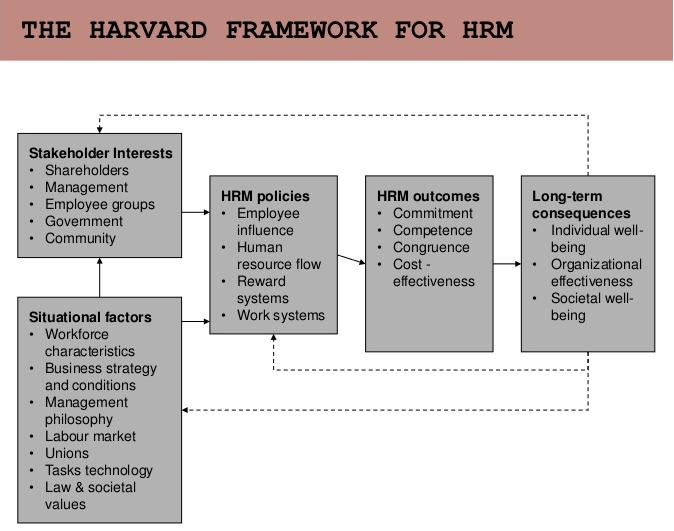
Harvard framework reflects Shareholders interests
which includes Shareholders, Management, Employee groups, Government and Community.
Situational factors influence stakeholders’
interest from Work force characteristics, Labour market, Unions etc.
Stakeholders & Situational interest
together creates HRM policies which is Employee influence, Human resource flow,
Reward systems, Work systems.
As a result of best HRM policies direct to
positive HRM outcomes.
Example; Commitment, Competence, congruence,
Cost effectiveness.
Positive HRM outcomes leads the organization
to long-term consequences where the it leads to Individual well-being, organizational
effectiveness and Social well-being.
Through this journey it is proved that human
resource management is not just a theory but it impact & motivate from
individual person to large corporation where it may lead to greater achievements.
Reference
The History of Human Resource
Management (HRM) (2015) Consensus HR.
Available at: http://consensushr.com/the-history-of-human-resource-management-hrm/.
Armstrong, M. (2014) ARMSTRONG’S HANDBOOK OF HUMAN
RESOURCE MANAGEMENT PRACTICE. 11th edn.
Jahan, S. (no date) George Elton Mayo -The father of
Human Resource Management, HRMP. Available at: https://hrmpractice.com/george-elton-mayo-the-father-human-resource-management/.
Kukreja, S. (2019) Human Resource Management Models, Management
study HQ. Available at: https://www.managementstudyhq.com/hrm-models.html.

Good work Shamina, You have clearly explained the history of the HRM. I think you explain more on the deference of PM & HRM, how it evolved and how it used in the organizations. Thank you.
ReplyDeleteMuch Appreciated the feedback
DeleteSimple but very well explained article..Thank you
ReplyDeleteThank you for the feedback Namila
DeleteGood job Shamina, However, in academic writing, you have to list whatever sources you have cited in your write up. For example, you have cited Guest, 1987, but it is not listed in the reference list. Please make sure to follow Harvard reference style as well.
ReplyDeleteThank you sir for your valuable time spend for reading and commenting in my blog. I have amended the references as advised.
DeleteClear explanation with the historical background, through the article we can understand the growth of HR from PM to HRM and it's positive impact to an organization. Good work Shamina.
ReplyDeleteThank you Jinendran, appreciate the feed back
DeleteGood work. You clearly mentioned history in line with present concept of HRM. Thanks.
ReplyDeleteThank you Sanka
DeleteHistory of HRM is clearly explained. Key functions explained in Harvard framework is essential in globalized corporate sector nowadays where all the functions have been digitized & modernized. Great effort Shami. Keep up the good work.
ReplyDeleteHistory of HRM has explained very well. Need of Harvard framework in corporate world has demonstrated pretty well. A simple yet fruitful collection of information. Good job Shamina..
ReplyDeleteStarting from history of HRM, definitions of HRM to Effectiveness of human resource management in corporate world , I see a nice flow and in-depth detailing of Harward Framework of HRM. Thank you for your effort and hope to see more posts. Nice work ! Cheers !
ReplyDeleteWell explained and nice flow it's very clear and easy to get the idea. nice work keep it up!
ReplyDeleteGood explaination on history of HR and Harvard framework in corporate world. Good job.. good luck...!!
ReplyDeletegood explain we can get more information in your article
ReplyDeleteClearly explain the history of HRM and effectiveness of HRM in corporate world .Good job Shamina !
ReplyDeleteGood article and nicely explained the history and the present HRM,captured some new things, good luck Shamina
ReplyDeleteBrief explanation with historic facts and the present HRM facts. Harvard framework connected to effectiveness of human resource management in corporate world is admirable. Good job. Thanks for sharing.
ReplyDelete