Tuesday, August 20, 2019

How to attract & retain millennials by Building an employer brand


How to attract & retain millennials by Building an employer brand

Millennials, who born between 1980-1999, by now aged 20-40 years old. Which means that they are the most active work force in global market place. The millennials are famous for switching between jobs till they get to fit to one.

To retain millennials, strong employer brand is more important than ever in the industry where the young talents is needed.
Image result for millennials

There are 05 ways to create employer brand. Let’s see using these tips how can we attract & retain millennials from Labour force.

01.  Know how the organization rate among the competition.

The organization may have a fun culture, attract to talents but is that fact known to others? This where an organization need a perfect blend of technology where millennial always will attract. Even showcasing the organization culture through social channels will bring the millennials because they are more active in those social networks. Following YouTube video will give some sort of idea on attracting employees to an organization through an Employer brand.


02.  Hire for Culture Fit

Rather than hiring based on resume qualification, an organization should consider to attract cultural fit candidates where skill comes in second. For that organization must look in to their best performers & worst performers. They should consider that what make them a rock star & what bad attitudes that employees share. Millennials will know that how much they get to fit the culture & It will make them stay longer in the organization. Watch following video where they have shared the hiring by cultural fit.


03.  Use visual story telling in job description.

Since the millennials are the digital generation using visual stories to hire them will be a more effective & a attractive way than a long paragraph of job description. The organization can show not tell that what they have expected from a employee in a better way


04.  Create a millennial-ready experience.

This tip directly targets the millennials since they are more like to networking, they will be the organization brand ambassadors. They will be promoting the organization among the required work force where Employer brand is all about.

05.  View hiring as a team sport.

Why should one person or two or three persons had to decide whom to hire & whom to fire. Most of jobs are all about team work where candidates must play a role as team member. Why not let a team decide on recruitment? millennials are more likely to engaged in a team work. In that case organizations should reach each staff & should know what are the weaknesses & strengths.


Reference

Steele, K. (2018) Five Tips To Create A Winning Employer Brand, Forbes. Available at: https://www.forbes.com/sites/forbesagencycouncil/2018/07/16/five-tips-to-create-a-winning-employer-brand/#60bdcbdd6fc9.

Peters, K. (2017) Want to Recruit Millennials? Focus on Your Employer Brand, Greate Place to Work. Available at: https://www.greatplacetowork.com/resources/blog/want-to-recruit-millennials-focus-on-your-employer-brand.

Slater, B. How to Hire For Cultural Fit, Talking talents By Beamery. Available at: https://beamery.com/blog/hire-for-cultural-fit.

Inalfa Roof Systems (2016) Employer Branding HR Movie, YOU TUBE. Available at: https://www.youtube.com/watch?v=icF7Q35zlTo.

Majumdar, A. (2017) Hiring for Culture Fit: What You Need to Know, YouTube. Available at: https://www.youtube.com/watch?v=BsdeV534nHg.

PeopleMattersOnline (2018) Building an Employer Brand for attracting millennials, YouTube. Available at: https://www.youtube.com/watch?v=JpWYd17NvP0&t=870s.


Friday, August 9, 2019

How Human resource management effect in corporate world


How Human resource management effect in corporate world

Image result for how Human resource management effect in corporate world


History of human resource Management

Around the end of 19th century, welfare officers appointed for protection of girls & women as a reaction to harshness and pressure of industrial conditions. We can consider it as a beginning of Human resource management. When the first world war begins, women were recruited and filled by large numbers to fill the gaps of men who were to engaged in war.  During 1920s “Labour Manager” “Employment Manager” job titles introduced to the engineering industry and where there were large factories. That role involved in recruitment, attendance handling, quires handling and dismissal. During the 1930s economy started to bloom, Big corporations saw value of improving employee benefits.

George Elton Mayo (1880-1949), Who we known as a father of Human resource management has done many researches. His employees conducted the practical experiments which enable him to decide how managers should behave in a corporation in order to improve productivity. His researches prove that Physical conditions or Financial conditions had little motivational value in the corporative world.


What Is human resource management?

Human resource management has many definitions.


  • Human resource management (HRM) is a strategic, integrated and coherent approach to the employment, development and well-being of the people working in organizations(Armstrong, 2014).


  • Human resource management involves all management decisions and action that affect the nature of the relationship between the organization and its employees – its human resources (Beer et al, 1984). 


  • HRM comprises a set of policies designed to maximize organizational integration, employee commitment, flexibility and quality of work (Guest, 1987).


Effectiveness of human resource management in corporate world

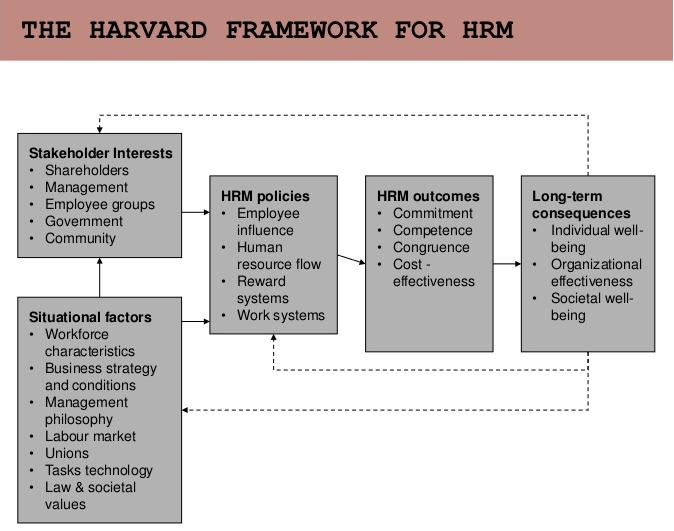
Human resource management is not an option but it’s a key priority in the corporate industry. Harvard model of HRM is the best way to explain how HRM effects in corporate bodies in a practical way. Harvard model of HRM was introduced by Harvard school of Beer et al in 1980s.


Harvard framework reflects Shareholders interests which includes Shareholders, Management, Employee groups, Government and Community.

Situational factors influence stakeholders’ interest from Work force characteristics, Labour market, Unions etc.

Stakeholders & Situational interest together creates HRM policies which is Employee influence, Human resource flow, Reward systems, Work systems.

As a result of best HRM policies direct to positive HRM outcomes.
Example; Commitment, Competence, congruence, Cost effectiveness.

Positive HRM outcomes leads the organization to long-term consequences where the it leads to Individual well-being, organizational effectiveness and Social well-being.              


Through this journey it is proved that human resource management is not just a theory but it impact & motivate from individual person to large corporation where it may lead to greater achievements.


Reference

The History of Human Resource Management (HRM) (2015) Consensus HR. Available at: http://consensushr.com/the-history-of-human-resource-management-hrm/.

Armstrong, M. (2014) ARMSTRONG’S HANDBOOK OF HUMAN RESOURCE MANAGEMENT PRACTICE. 11th edn.

Jahan, S. (no date) George Elton Mayo -The father of Human Resource Management, HRMP. Available at: https://hrmpractice.com/george-elton-mayo-the-father-human-resource-management/.


Kukreja, S. (2019) Human Resource Management Models, Management study HQ. Available at: https://www.managementstudyhq.com/hrm-models.html.